
Upskilling African Data Talent For the Future of AI
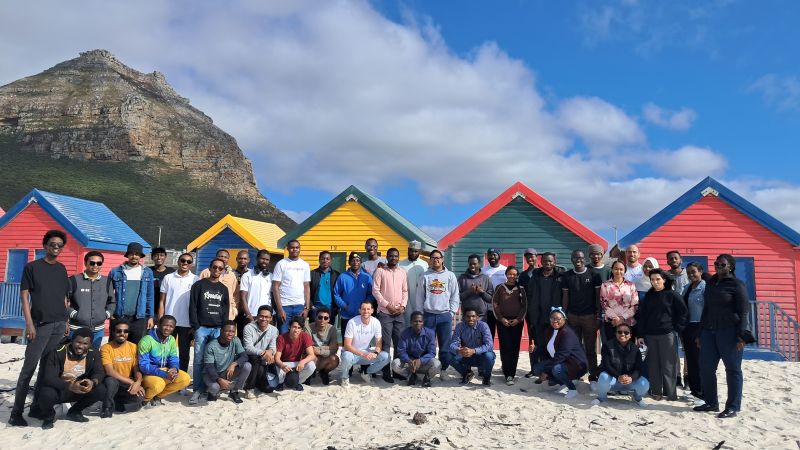
Ishango.ai was recently excited to once again partner with the African Institute for Mathematical Sciences (AIMS) in Cape Town!
Our team—Cyrille Feudjio, Vincent Aduuna Frimpong, Jan Ravnik, and Oliver Angelil—spent three intensive weeks lecturing an applied MLOps & Data Engineering course to 39 talented MSc students representing nine African nations.
While the world of AI is often enamored with the “tip of the iceberg”—the flashy User Interface or the generative prompt, our team focused on getting students ready for industry, by tackling the real challenge underneath the surface. How do you take a scrappy Python notebook used for a basic Proof of Concept (POC) and transform it into a production-ready data product?
A production system must be:
- Rapidly Scalable: Handling increasing loads without breaking.
- Easily Maintained: Clean, modular code that others can update.
- Automated: Deploying updates without manual intervention.
To bridge this gap, we didn’t just teach theory; we taught the “boring” but essential fundamentals that define a high-level technical lead. Here is a deeper look at the competencies the Ishango team equipped the students with:
1. Architecting the Environment: Containerization & Microservices
We moved students away from “it works on my machine” by mastering Docker. By wrapping applications in containers, students learned to ensure consistency across development, testing, and production environments. We explored Microservices architecture, teaching them how to break down monolithic applications into modular, manageable components that communicate via RESTful APIs (FastAPI).
2. Software Engineering Excellence
Data science is software engineering. We focused heavily on Software Development Best Practices, including:
- Branching Strategies: How to collaborate on large codebases using Git without causing chaos.
- Coding Style: Writing “clean code” that is readable and follows PEP 8 standards.
- CI/CD: Using GitHub Actions and Google Cloud Platform to automate testing and deployment, ensuring that every code change is verified before it hits the “live” server.
3. Modern Data Engineering & Design
Data is the fuel for ML, but raw data is rarely ready for consumption. We delved into Data Model Design Patterns, comparing Kimball (Star Schema) vs. One Big Table (OBT) on a Lakehouse architecture. Students utilized Dagster for automated orchestration, learning how to build resilient data pipelines that don’t just run, but “self-heal” and provide clear observability.
4. Scaling and MLOps
When data hits a certain scale, single-node compute isn’t enough. We compared Distributed Cluster Computing (Databricks) against high-performance single-node libraries like Polars. To round out the lifecycle, we used MLflow to log experiments, version models, and manage the entire ML lifecycle—ensuring that the “Science” in Data Science is reproducible and trackable.
5. The Future: Agentic AI
We couldn’t leave without touching the horizon. We hosted bonus lectures on Agentic AI—moving beyond simple chatbots to systems that can reason, use tools, and execute multi-step tasks. This empowered students to identify where the GenAI hype ends and legitimate, high-value use cases begin.
The highlight of the trip was seeing the “Ishango Full Circle” in action. Cyrille Feudjio, once an AIMS student himself, and currently an Ishango.ai data scientist placed at Elder Research, returned to AIMS as a lecturer. This is the heartbeat of our mission: fostering a self-sustaining ecosystem of world-class technical talent in Africa.
Thank you to all the students for their incredible energy. The future of African data science and engineering is in very capable hands! 🇿🇦 🇬🇭 🇳🇬 🇲🇬 🇸🇩 🇪🇬 🇺🇬 🇰🇪 🇪🇹 🇧🇯
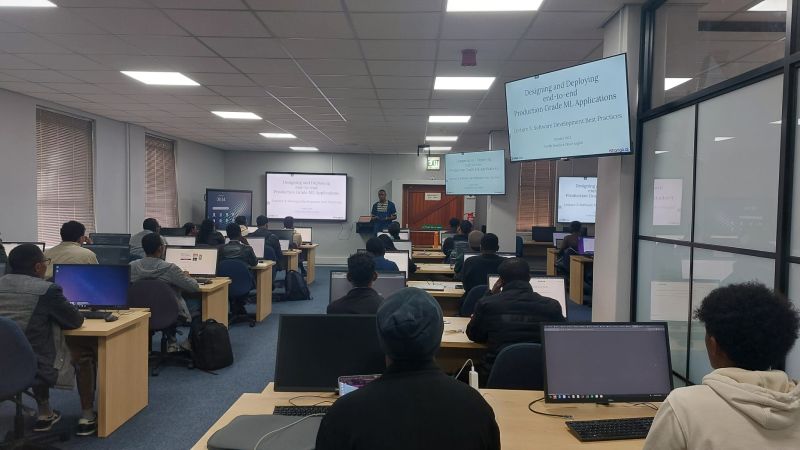
|
Latest Posts
-

From Data to Decisions: How AI Agents Are Transforming Business Strategy
The landscape of artificial intelligence is shifting dramatically. Since groundbreaking research in 2017, generative AI (GenAI) has surged.
-

Transforming Data into Value: A Practical Guide
My time immersed in a high-stakes data science environment at a major financial institution revealed a stark truth: data initiatives, while brimming with potential, are fraught with risk.
-

How to Evaluate Your Company’s AI Potential
In the race to integrate artificial intelligence, understanding your company’s true capacity for AI success is more critical than simply adopting the latest technology.
Subscribe To Our Monthly Substack!
For research-backed Data & AI content that helps business leaders unlock value from data.